Executive summary
Inaccessible housing is a measurable structural failure of the UK housing stock. Tens of millions live in homes that constrain mobility, independence and long-term health. This analysis synthesises architectural constraints, regulatory frameworks, government delivery mechanisms such as the Disabled Facilities Grant (DFG), and the psychosocial consequences of poor housing design. It concludes with practical technical considerations for retrofitting and a note on emergent technological matching tools.
The scale of the problem
Recent national surveys show that a substantial share of the population experiences long-term limiting illness or disability: around 14 million people in the UK — roughly one in five — report a disability or long-term health condition that affects daily activities. Demographic ageing compounds the issue: people aged 65 and over constitute approximately 18% of the population and are the fastest-growing age group. These two trends put pressure on a predominantly pre-war and mid-century housing stock that was not designed for lifelong adaptability.
DFG and the policy gap
The Disabled Facilities Grant is the principal state mechanism to subsidise major home adaptations (e.g. accessible bathrooms, level access showers, structural widening). However, delivery is fragmented: grants are administered by local authorities with widely varying eligibility thresholds, means-tests and waiting times. Surveys of local authority practice report median waiting times from initial referral to work completion often measured in months, commonly six to twelve months for significant adaptations. The result is a mismatch between need and timely intervention: delays exacerbate health risks and increase downstream public costs (hospital admissions, social care packages, early care-home placement).
Architectural barriers in existing homes
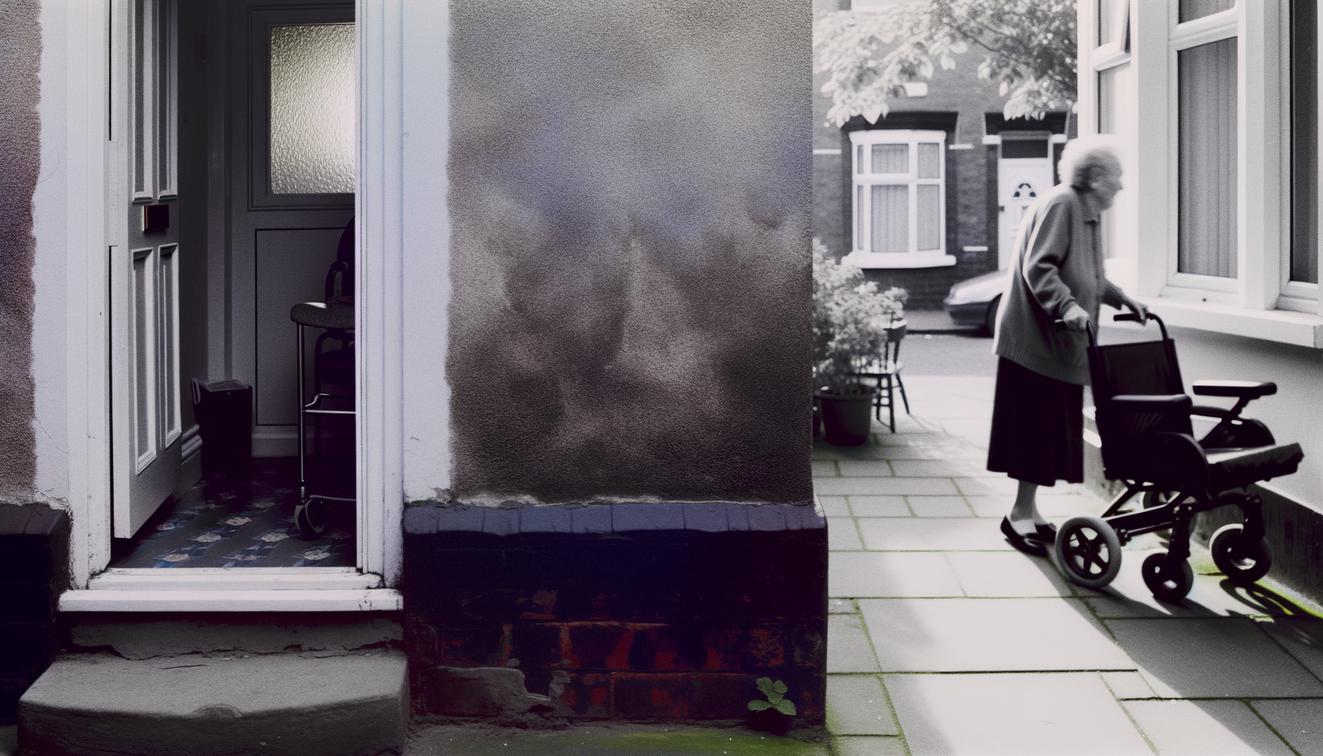
Architectural barriers fall into predictable categories: thresholds and steps, constrained circulation spaces, inaccessible wet rooms and bathrooms, narrow doorways and inadequate manoeuvre zones, and kitchens with poor reach ranges.
Technical dimensions
Key measurable parameters determine usability. Examples include: doorway clear widths (minimum 800–900 mm for many wheelchair users), turning circles (a 1500 mm diameter manoeuvre space for 180° turns), and ramp gradients (short external ramps commonly use 1:12; longer runs favour gentler gradients approaching 1:20). Bathroom design requires specific transfer zones: a clear side-transfer width of at least 750–800 mm beside WC/bed, and shower thresholds that can be eliminated with level access, or reduced to a maximum 15 mm upstand where unavoidable. These are not arbitrary: they derive from Part M of the Building Regulations, BS 8300 and British Standards guidance which set dimensional minimums to enable independent use.
Retrofitting constraints
Retrofitting is technically feasible in many cases but constrained by building form, listed-status, structural limitations and cost. For terrace and semi-detached stock, common interventions include threshold reconstruction, stair lifts or through-floor lifts, reconfiguring ground-floor layouts for bedroom and wet-room provision, and kitchen adaptations (lowered worktops and pull-out units). Each intervention has a technical chain of dependencies: e.g. installing a through-floor lift may require floor strengthening, alterations to bearing walls and fire-stopping measures — adding cost and delay.
Health, social and economic impacts
There is a growing evidence base that well-designed adaptations reduce falls, improve medication adherence and slow transitions to institutional care. Clinically, domiciliary adaptations and timely repairs correlate with improved functional independence scores in older adults and fewer emergency admissions for fall-related injury. Economically, small to medium-scale adaptations can offset larger social care costs: a single avoided residential care placement represents a multi-year cost saving that exceeds the one-off adaptation cost in many cases.
Psychology of independent living
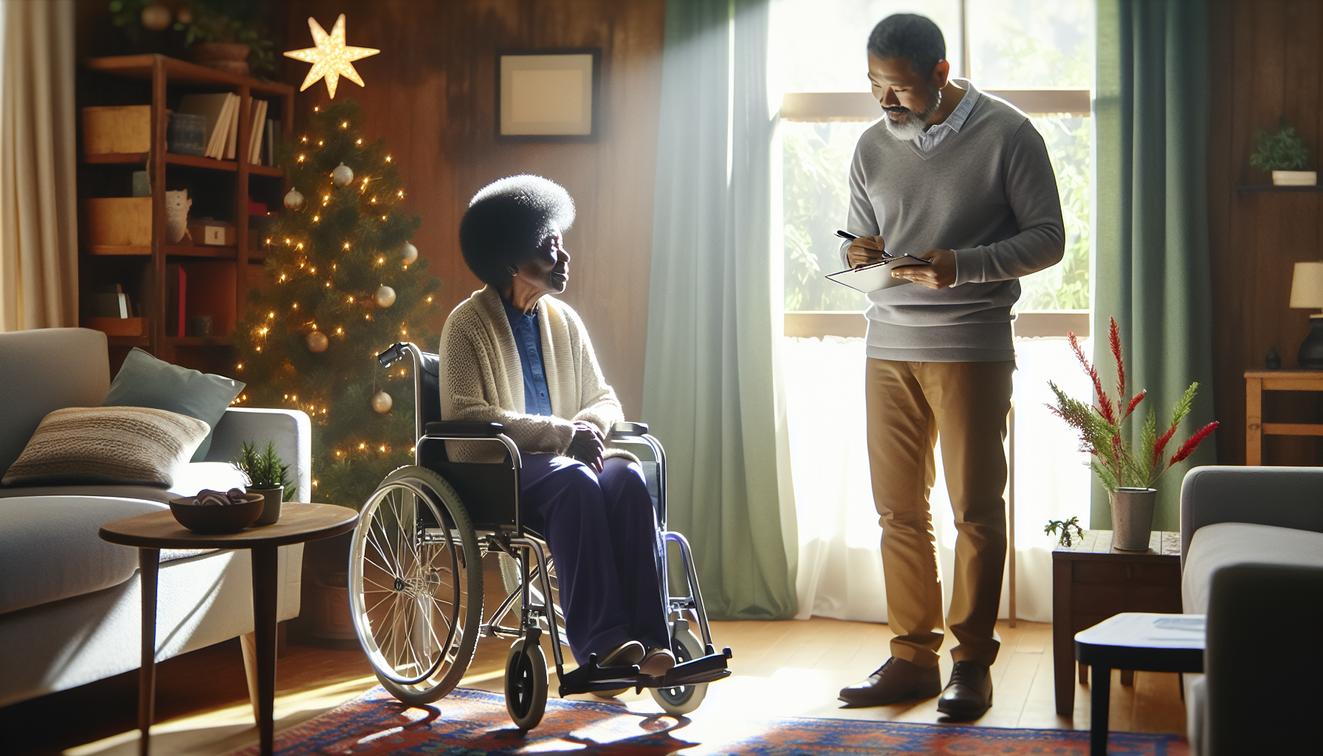
Psychological research on ageing in place emphasises two linked mechanisms: perceived control and environmental mastery. Accessible homes preserve autonomy, reduce caregiver burden and support social participation. Conversely, architectural barriers increase dependence, reduce mobility, and heighten social isolation — factors associated with depression and cognitive decline. Interventions that preserve independence therefore carry both measurable clinical and psycho-social benefits.
Regulatory and delivery challenges
Part M of the Building Regulations and BS 8300 set minimum standards for access and inclusive design, but regulatory reach is limited by the distinction between new build/alteration and existing private stock. Many privately owned homes fall outside mandatory upgrade paths. Local authority enforcement and planning negotiations for minor works rarely secure retrofit outcomes at scale.
Variability in local delivery
Local authorities face resource constraints, variable contractor markets, and complex occupational therapy (OT) assessment processes. The result is spatial inequality: some localities deliver rapid, comprehensive adaptations; others experience long delays and narrow eligibility. The DFG budget and broader capital allocations determine throughput; when budgets are constrained, authorities prioritise highest-risk cases, leaving many with moderate need unsupported.
Technical best practice for effective adaptations
Effective adaptations require integrated assessment and a standards-based specification. Core recommendations derived from standards and practice include:
- Early multidisciplinary assessment (OT, structural engineer, architect) to identify options and sequence works.
- Prioritise low-regret, high-impact changes first (level thresholds, grab rails, non-slip surfaces, lever handles, clear circulation widths).
- Use universal design principles where possible: step-free entrance, adaptable bathroom footprint, and reinforce flooring in locations likely to require lifts.
- Document dimensional requirements precisely in procurement documents (e.g. minimum clearances, ramp gradients, load-bearing specifications) to reduce variation and rework.
Cost and procurement considerations
Costs vary widely: a basic accessible shower installation may cost a few thousand pounds; major structural reconfigurations, through-floor lifts or extensions run into tens of thousands. Cost-effectiveness improves with standardised procurement frameworks, bulk purchasing of repeatable components (level-access threshold kits, modular wet-room panels) and maintained OT-led specification to avoid over-engineering.
Data gaps and measurement priorities
Policy and practice would benefit from standardised national metrics: prevalence of barrier types by dwelling stock, average waiting times for DFG-funded works, outcomes measured as delays to institutionalisation, and longitudinal tracking of hospital admissions pre/post-adaptation. Routine collection of these measures would enable robust cost–benefit analysis and prioritisation of interventions that deliver the highest public-value return.
Research priorities
Key research gaps include controlled longitudinal studies quantifying the precise effect sizes of different adaptation types on health service utilisation, granular mapping of accessibility shortfalls by housing typology, and trials of procurement and delivery models that shorten lead times while preserving quality.
Policy levers and practical recommendations
Practical policy actions include: increasing the DFG throughput with ring-fenced capital and streamlined OT assessments; incentivising private landlords to implement minimum access measures through regulation or tax credits; embedding universal-design requirements in permitted development guidance for retrofits; and creating regional retrofit hubs to aggregate demand and professionalise delivery.
Conclusion: technology, matching and the road ahead
Bridging the accessibility gap demands coordinated improvements in regulation, funding, clinical pathways and technical standards. Digital tools can reduce friction in the system by standardising assessments, automating parts of specification and matching homes to adaptation pathways. Platforms like Homingo are now using AI to automate this complex matching process — mapping individual functional needs to suitable properties and suggesting standardised adaptation packages — illustrating one technological approach to reducing delay and improving targeting. Any technological intervention must however be integrated with clinical oversight, rigorous data governance and alignment with Part M/BS 8300 standards to deliver measurable benefits.